Why Methodology Updates Matter - and Why They Usually Don't
When the EU’s Joint Research Centre updates the characterisation factors underpinning the Product Environmental Footprint (PEF) method, it reflects the continuous improvement of LCA science as new knowledge and calculation approaches emerge. In traditional LCA workflows, a methodology version update triggers a manual recalculation of every historical assessment in your backlog before old and new results can meaningfully be compared. For a company with a large product portfolio, that is a considerable overhead every time the science moves forward.
We have recently updated Sustained from EF3.0 to EF3.1. For our users, nothing changed. The update happened automatically in the background, and every product in your portfolio is already running on the new method. This post explains what changed scientifically, why it matters, and why it should be the last methodology update you ever have to think about.
LCA Fundamentals
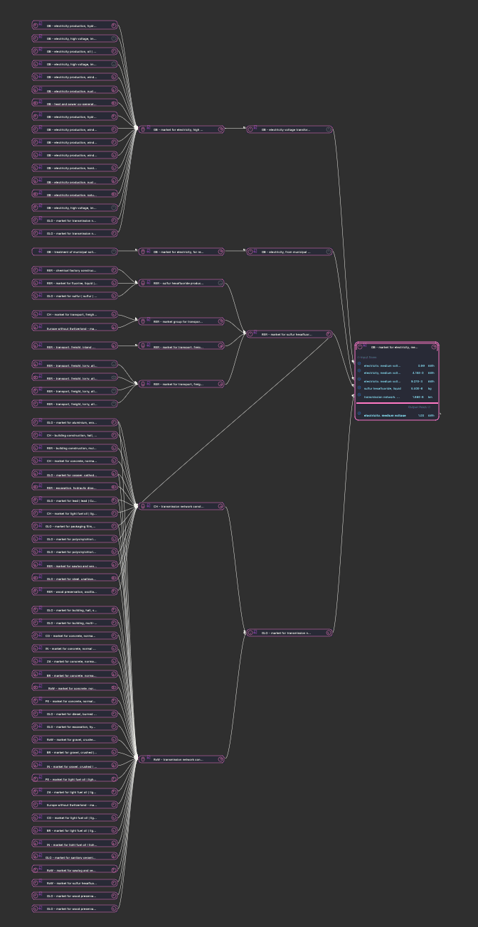
Before getting to the methods, it helps to establish a common understanding of how LCAs work. At their foundation, LCAs are a large array of sums of exchanges with the environment. Any process or action causes flows to and from the environment, take the simple example of bottling drinking water. Spring water is extracted from the environment, but before that step, other flows have already occurred: to produce the electricity running the pumps, fuel may have been burned and a long list of exhaust gases released into the air. Similarly, producing that fuel and those generators involved their own emissions and extractions. That list of flows grows exponentially with every step up and down the supply and distribution chain, as each process is composed of its own sub-processes and elementary flows. The result is, in effect, a balance sheet for the environment, listing all emissions and resource extractions. (To provide an idea of the emerging complexity, in the image below, I have taken a screenshot of an exemplary electricity market secondary dataset’s model graph. As you can see, just 3 levels down, the number of processes grows unwieldy.)
The image below illustrates this complexity using a secondary dataset model graph for an electricity market. Just three levels down, the number of processes becomes unwieldy — and this is for a single input in a single product.
To manage this complexity, the cumulative balance of flows is commonly represented as a matrix. We will leave the mathematical detail aside here, though a more technical treatment may follow in a future post. What matters is this: when you trace all the inputs and outputs across a model’s processes, the result is a list of elementary flows. Trace far enough back, and all activity reduces to exchanges with the environment. This is where the methods come in.
What Are Characterisation Factors and Why Do They Change?
Methods take that long list of elementary flows and assign each one a characterisation factor (CF) for a given impact category. For climate change, for example, CFs convert flows into carbon dioxide equivalents. Carbon dioxide to air carries a CF of 1 [kg CO₂e / kg], while Pentafluoroethane carries a CF of 3740 [kg CO₂e / kg]. In the impact category Human Toxicity (non-cancer), Pentafluoroethane has a CF of 1.3667E-9 [CTU/kg], while carbon dioxide carries no weight in that category at all - effectively a CF of 0.
In some cases, CFs vary not only by substance but also by location. Water is one such case: EF uses the AWARE methodology to calculate water deprivation values, meaning the same volume of groundwater carries a different CF depending on where it is extracted. The UK and Egypt, for instance, represent very different levels of water stress, and the method reflects that.
What Changed in EF3.1 and Why It Matters
The evolution of LCA methods is driven by the scientific community’s ongoing pursuit of greater precision. The EU’s Joint Research Centre (JRC) published updated characterisation and normalisation factors for EF3.1, reflecting the latest scientific findings and consensus. LCAs conducted using EF3.1 therefore rest on a more rigorous quantitative foundation than their predecessors.
For most users, these changes are incremental. Where an individual dataset’s impact shifts more noticeably, aggregation with other datasets across the full LCA typically smooths the effect. When you view your product’s impact or generate a report, you will most likely see only minor changes relative to EF3.0. But incremental or not, the update keeps your assessments on a defensible, current footing.
How Sustained Handles EF3.1 - Automatically
In traditional LCA practice, a methodology change triggers manual recalculation of the entire historical backlog before older and newer assessments can meaningfully be compared. With Sustained, it’s automatic. The update happens seamlessly in the background, ensuring your product portfolio’s LCAs remain consistent, comparable, and calculated against the latest EU method without any action on your part. This is part of a broader approach to automating the overhead of LCA management.
Regulations and scientific standards will continue to evolve. With Sustained, your LCAs evolve with them, automatically, consistently, and without manual overhead. If you want to discuss what EF3.1 means for your specific product portfolio, get in touch.
Frequently Asked Questions
Q: What is the difference between EF3.0 and EF3.1?
A: EF3.1 updates the characterisation and normalisation factors that underpin the Product Environmental Footprint framework, based on the most recent scientific consensus. The most significant changes are: climate change characterisation factors have been updated to align with AR6, the IPCC’s Sixth Assessment Report (2021); the metals and inorganics sub-indicators have been consolidated into a single ecotoxicity category; and normalisation factors (which allow different impact categories to be compared on a common scale) have been revised. For most products, the practical effect on calculated impact will be small, since individual dataset changes tend to be smoothed out through aggregation. But the update matters for defensibility: assessments grounded in EF3.1 reflect the current state of the science.
Q: Do I need to recalculate my LCAs when the EF method is updated?
A: In traditional and manual LCA workflows, recalculation is required to maintain comparability across your portfolio. Without it, assessments run on EF3.0 and EF3.1 cannot be reliably compared, since differences in results may reflect the method change rather than any real change in environmental performance. For companies managing large product portfolios, this can represent a significant and recurring workload every time the methodology advances.
With Sustained, no manual action is required. When the method updates, the change is applied automatically and consistently across your entire portfolio. Every product is recalculated on the new basis, and comparability is maintained without any intervention from your team.
Q: What is the Product Environmental Footprint (PEF) method?
A: The Product Environmental Footprint is the EU’s standardised framework for measuring and communicating the environmental impact of products across multiple impact categories, from climate change and water use to toxicity and land occupation. Rather than reporting each category separately, PEF combines them into a single weighted score by normalising results against reference values, allowing different products and portfolios to be compared on a consistent basis.
PEF is increasingly relevant for food and consumer goods brands operating in European markets. It underpins the methodology requirements of the EU Green Claims Directive, which requires companies making environmental claims to demonstrate that those claims are substantiated by recognised scientific methods. Sustained Impact has been built to conform with the PEF framework from inception. For a deeper discussion of how PEF applies to complex multi-ingredient products, see our guide to automating LCA for multi-ingredient food products.
Q: What are characterisation factors in LCA?
A: Characterisation factors (CFs) are the multipliers that convert elementary flows, the raw inputs and outputs exchanged with the environment, into a common unit for a given impact category. For climate change, a CF converts a quantity of a substance emitted (in kg) into kg of CO₂ equivalents, allowing gases with different warming potentials to be compared directly. For other categories, different units apply: the human toxicity category uses Comparative Toxic Units (CTU), for instance.
CFs are updated as scientific understanding improves, which is why method versions exist, and why keeping assessments on the current version matters. As described above, the transition from EF3.0 to EF3.1 reflects exactly this kind of scientific revision.