Solutions · by outcome
Solutions · by role
Resources
Expert perspectives on LCA, eco-design, compliance, and environmental intelligence.
Discover how ingredient mapping and proxy methodologies in LCA address data gaps, ensuring transparency and scalability for food and beverage manufacturers.
Matthias Reich · 13 May 2026 · 6 min read
The EU's Joint Research Centre has updated the PEF method's characterisation factors from EF3.0 to EF3.1, reflecting the latest advances in LCA science. Here's what changed and what it means for your environmental footprint calculations.
A manual LCA for a lasagne with 35+ components can take four to six weeks per product. Automation addresses the data granularity, methodological consistency, and scalability challenges that make manual assessment impractical at portfolio scale.
Tazaki Foods footprinted over 1,000 SKUs and uncovered reformulation opportunities by sharing product-level emissions data directly with their suppliers.
Building on Part 1's framework introduction, this article demonstrates how to interpret your LCA results using planetary boundaries, connecting product-level impacts to Earth-system thresholds.
The PEF method evaluates products across 16 environmental categories, while the Planetary Boundaries framework defines nine Earth-system thresholds. Understanding how they relate is essential for interpreting LCA results in a broader ecological context.
The EAT-Lancet Commission's October 2025 report on feeding 10 billion people by 2050 has major implications for food product strategy. Plant-forward diets, ultra-processing scrutiny, and waste reduction are reshaping the competitive landscape.
The traditional trade-off between detailed manual LCAs and quick automated screening assessments is dissolving. Modern technology delivers both speed and rigour without compromise.
Most companies prioritise carbon when reformulating products, but the largest environmental opportunities often exist in unmeasured impact categories. A multi-impact approach to reformulation reveals wins that single-metric strategies miss entirely.
Packaging offers a significant and often untapped opportunity to reduce environmental impact without changing the product itself. Both packaging manufacturers and brands can leverage data to make better material and design choices.
Many food and beverage companies recognise the importance of measuring environmental impact but fail to grasp how their own contributions to environmental degradation create tangible business risks.
In 2025, the bigger question is not just what your footprint is, but where you are exposed. Impact data provides the foundation for identifying supply chain risks before they materialise as financial losses.
The biggest challenge in LCA is access to primary data. No company can audit its entire supply chain, so finding the right balance between primary and secondary data is both a practical necessity and a methodological requirement.
B Corp certification received its seventh major update in April 2025, shifting from a points-based system to mandatory minimum requirements. The new standards significantly expand environmental and supply chain expectations.
In a market crowded with sustainability claims, verifiable LCA data provides the foundation for credible product differentiation that withstands scrutiny from retailers, regulators, and consumers.
Integrating sustainability into procurement can cut costs by up to 16%, according to Rabobank. The key is using targeted environmental data to identify efficiency gains that deliver both financial and environmental returns.
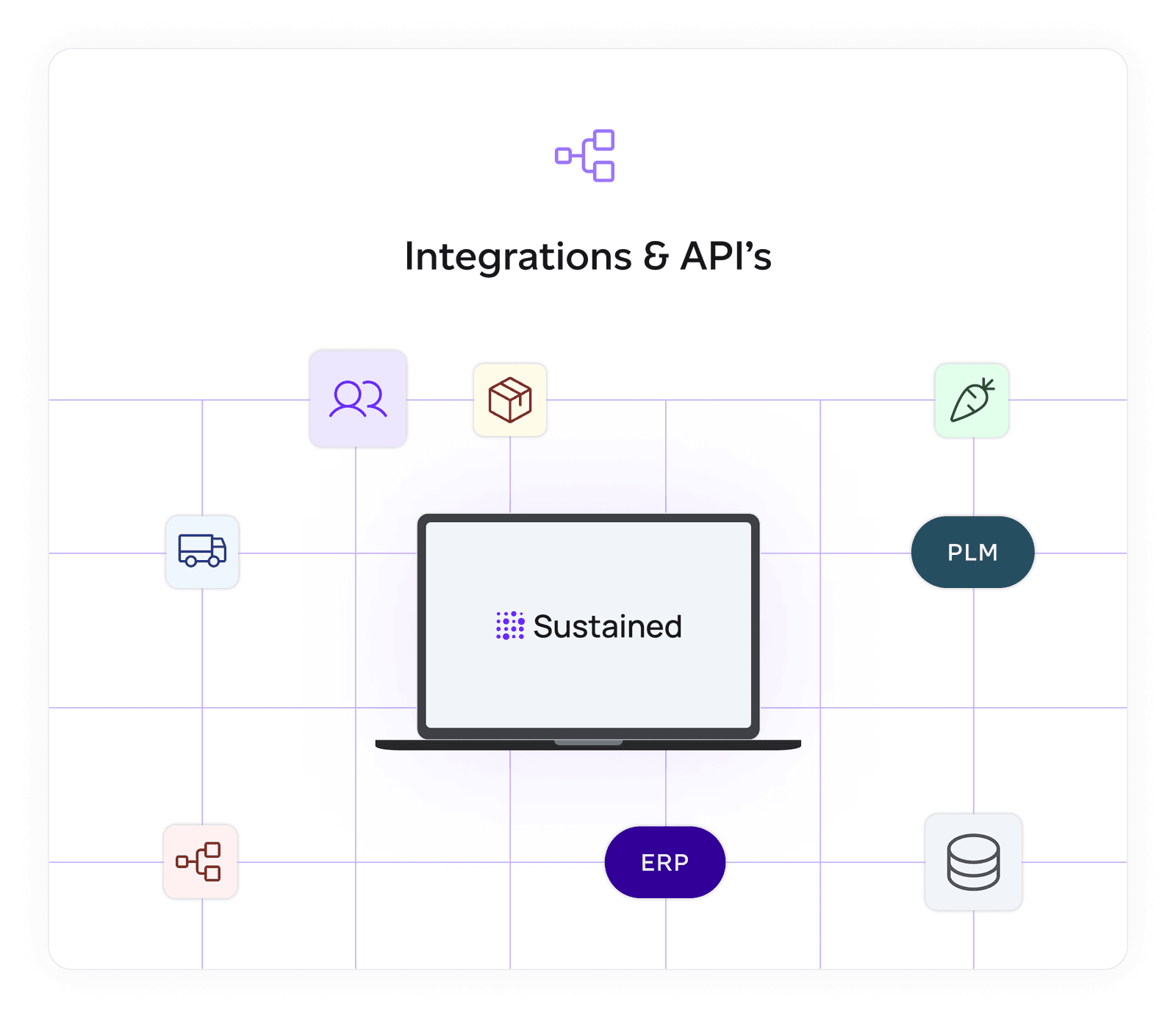
Integrate environmental impact data into your existing PLM or ERP systems seamlessly with Sustained’s API without disrupting workflows.
Understand the concept of allocation in Life Cycle Assessment (LCA) and its methods—physical and economic allocation—along with their pros and cons.
Eco-design in food production integrates sustainability from gate 0 to minimise footprint. Discover Sustained's comprehensive eco-design platform.
Explore the role of biodiversity in sustainable food practices. Learn about quantifying impacts, methodologies, and how PEF assesses biodiversity.
Discover the dangers of greenwashing in sustainability, its costs, how to spot it, and ways to avoid it. Learn about the EU's Green Claims Directive.
Explore key sustainability concepts like recycling vs. upcycling, climate change vs. global warming, and more.
Learn how the hospitality industry can reduce food and beverage-related Scope 3 emissions with Sustained. Download the full guide for effective strategies.
Gain clarity on sustainability concepts: Learn key terms like Net Zero vs. Carbon Neutral and more in this insightful blog.
Explore how system boundaries impact the results of an LCA and discusses how standardised frameworks like PEF can be used mitigate misunderstandings.
Prioritise impact reduction efforts with broad product insights in this comprehensive guide on sustainability journey for food manufacturers at Sustained.
Explore how LCA automation is transforming sustainability practices, with scalable solutions to quantify & lower environmental footprints.
Discover why Sustained chose the Product Environmental Footprint (PEF) framework for Life Cycle Assessments in the food industry.
Carbon accounting & product-level LCAs are essential in the green economy. Meet customer demands, stay ahead of regulations, and gain competitive advantage
Sustained joins TechNation Climate 2024 cohort, highlighting their commitment to driving environmental impact reduction in the food system.
Addressing the disconnect between our everyday lives and the environmental, we explore the urgency of changing our economic model to save the environment.
Sustained is joining forces with Foundation Earth - an independent, non-profit organisation issuing front-of-pack environmental scores on food products - t
Ever find yourself wandering the aisles of the supermarket wondering about the sustainability of your food choices? Or the impact of your food on issues su
Most of us find the topic of food packaging important. We know that packaging generates a lot of waste, especially plastic, and plays a significant role in
At first sight, this is a simple question. One that, when I Googled it, I thought should have brought up a list of things that I can eat and feel good abou
Today climate change is one of the hottest topics among politicians, business people, scientists and citizens worldwide. The younger generation is horrifie
When Michael and I set out on this adventure, I had only a vague sense of the importance of sustainability to our everyday life, and arguably more importan
When we think of sustainability, and more specifically the environment, the first three things that come to mind are ‘Climate Change’, ‘Environment’ and ‘C
Sustainability is often seen as an all or nothing game. For many, it feels like you have to be an off-the-grid vegan or nothing. But that is not the case.
There is a lot of information out there, but with wealth of information comes misinformation. It’s no secret that our planet is undergoing a serious crisis
Environmental, Social and Governance You may be thinking: “you’ve just told me what ESG means, why should I keep reading?” For one, I can almost guarantee
We are often told that we need to live more sustainably. But what exactly does it mean? The enormity of this concept used to paralyse rather than motivate
I have grown up hearing about climate change and greenhouse gases (GHGs) and how they have a negative impact on our environment and planet. I have also lea
The state of the environment can feel overwhelming. With everything else going on in the world, it can almost feel nihilistic. And so, while we normally ta
Sustained is as much about transparency as it is about education. While we regularly talk about discoveries we have found whilst creating the app, we are y
A fine question indeed! Nothing in my or my co-founder Carl’s careers suggested an interest in sustainability, ecology or the environmental impact of human
Nowadays, we see and read a lot about governments, businesses, and movie stars encouraging actions against climate change. Recent events like COP26 in Glas
Lifecycle assessment (LCA) is an endless topic. First of all, let's agree on one fact: everything has a lifecycle. It consists of raw materials extraction,
What is the best alternative milk? This seems to be the question on everyone’s mind. One minute it’s almond, the next soy, and then oat. The list goes on
Sustainability has become a hot topic over the past few years. People and organisations alike have been aiming to become more sustainable. Over time with m
I never cared about food seasonality before spending 6 months in Portugal in 2013 as a student. There were several reasons why this topic became so relevan
Having arrived at paradise island in Malaysia, I noticed these white-bone-like structures underwater near the shore. Investigating further, I learnt that t